For decades, the standard narrative of Omaha’s expansion was simple: head west. However, macro growth dynamics across the metro area are undergoing a major shift. The historically unfettered westward sprint is cooling, giving way to a more balanced, multi-directional growth pattern.
Driven by regional cooperation through the Metropolitan Area Planning Agency (MAPA) and its Heartland 2050 framework, infrastructure and residential development are accelerating dramatically to the South, East, and North.
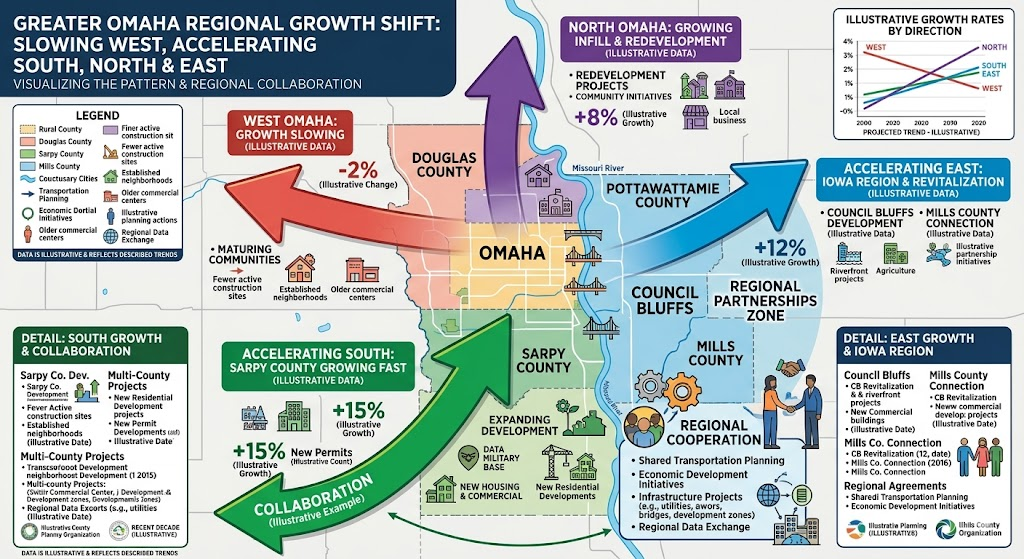
The Shift in Metro Growth Vectors
1. South: The Sarpy County Explosion
Sarpy County is currently the fastest-growing county in Nebraska, expanding at an annual rate of 1.85%—nearly double that of Douglas County.
- The Drivers: Massive infrastructure investments along the Highway 370 and I-80 corridors have turned Papillion, Gretna, and Bellevue into hotbeds for residential master-planned communities.
- The Tech Factor: The multi-billion dollar data center corridors (Meta, Google) act as massive anchors drawing auxiliary commercial and workforce growth southward.
2. East: The Council Bluffs & Mills County Revitalization
Growth toward the east is breaking the traditional state-line barrier, turning the Missouri River into a shared urban center rather than a boundary.
- Council Bluffs (Pottawattamie County): Major investments like the River’s Edge mixed-use waterfront development and the 1st Avenue multi-modal corridor are actively pulling density back toward the historical core.
- Mills County: Serving as an increasingly attractive suburban and exurban destination for commuters who want acreage while staying connected to the I-29 and US-34 logistics corridors leading into Douglas and Sarpy County.
3. North: Targeted Infill and Logistic Corridors
Northward expansion focuses on balancing industrial logistics with equitable housing infrastructure.
- The Strategy: Expansion along the Highway 75 and I-680 corridors connects industrial submarkets near Blair with new residential infill projects in North Omaha, emphasizing transit-oriented development (TOD) and missing-middle housing. So far growth into Washington County has been slow and the county is maintaining its rural character
4. West: Maturing and Densifying
Westward growth isn’t stopping entirely, but it is changing shape. As development approaches geographical and utility thresholds, the focus is shifting away from endless single-family sprawl and toward dense, self-contained, mixed-use nodes like Heartwood Preserve.
Omaha’s outward westward growth is strictly limited by the Elkhorn Ridgeline. Extending the Papillion Creek Sewer System across this ridgeline and into the floodplain is prohibitively expensive and environmentally unsustainable. As a result, the city estimates that outward expansion will reach its physical and infrastructural limits by 2050. However we are already seeing limits to westward growth of Omaha and a shift to densification in areas like Blackstone, Benson, and Midtown as westward growth becomes more costly.